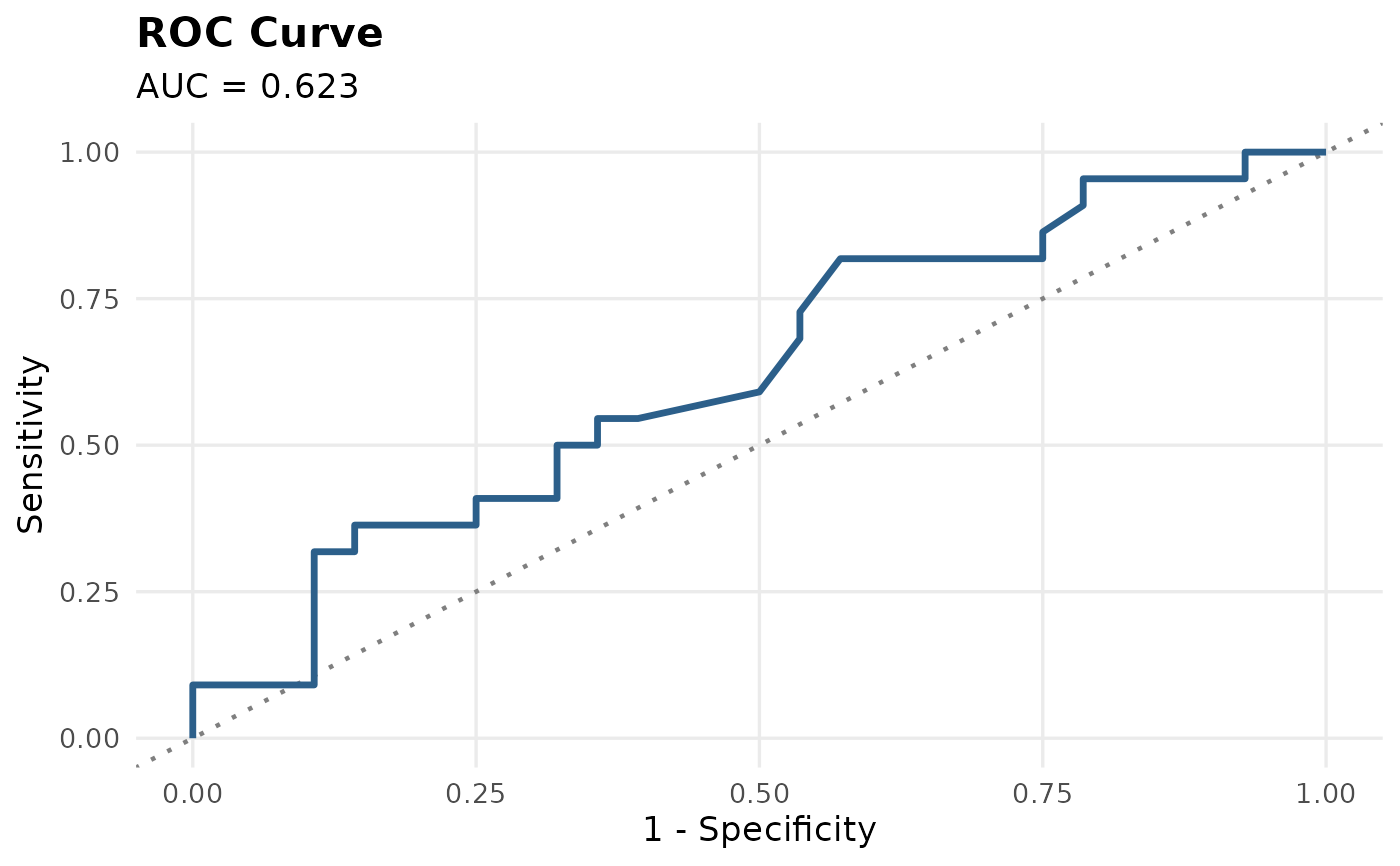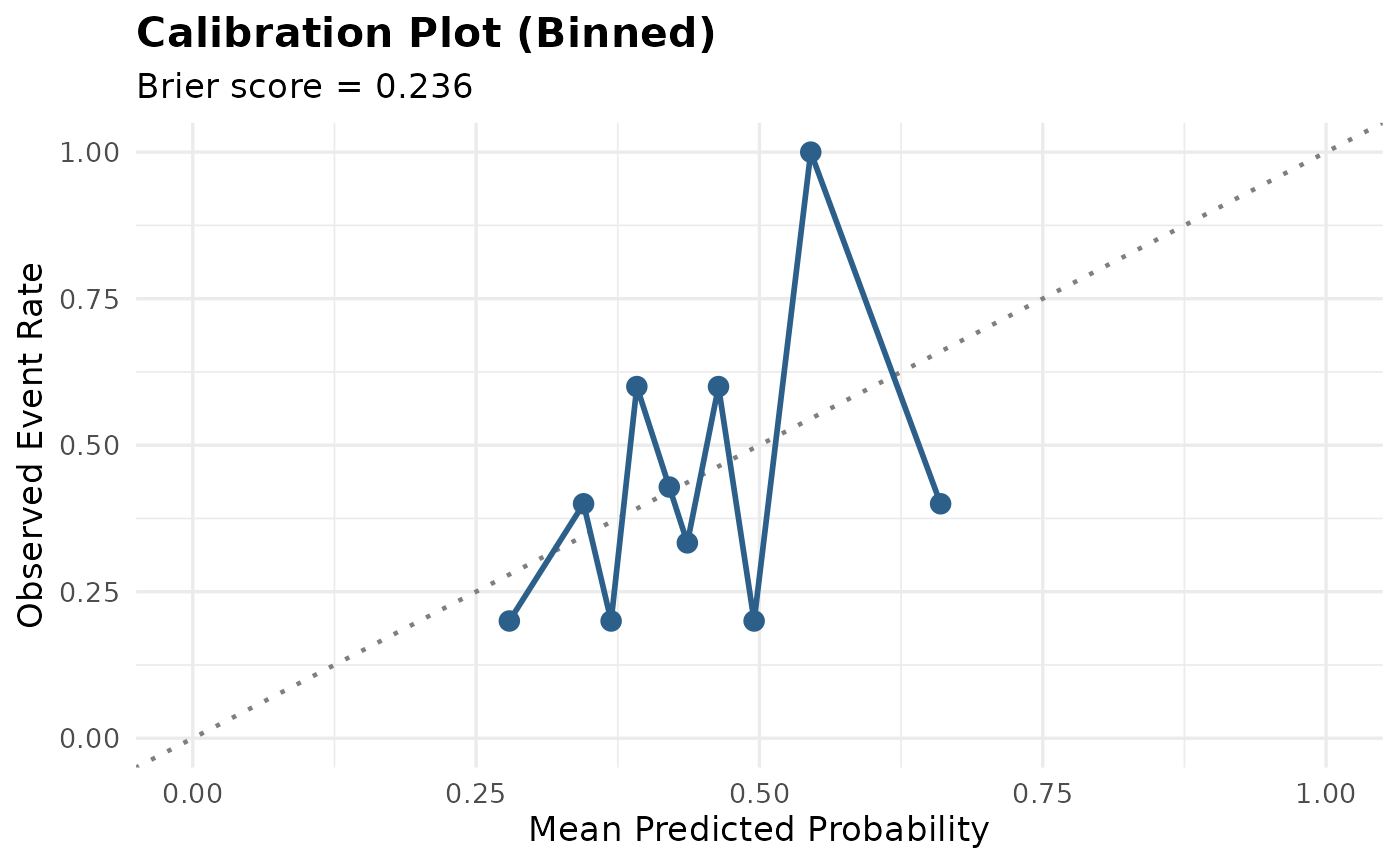
Computes discrimination (AUC, sensitivity, specificity) and calibration
metrics for a fitted triageR_model. Can validate on new (external/holdout)
data, or fall back to the training data with a clear warning.
Usage
tr_validate(
  model,
  newdata = NULL,
  threshold = 0.5,
  calibration_method = c("binned", "smooth")
)
Arguments
- model
A fitted
triageR_modelobject fromtr_fit().- newdata
Optional data frame to validate on. If
NULL(default), validation runs on the original training data, with a warning.- threshold
Numeric. Probability threshold for classifying the positive class. Defaults to 0.5.
- calibration_method
Character. One of
"binned"(groups patients into risk deciles, the standard clinical approach) or"smooth"(loess-smoothed calibration curve, more granular). Defaults to"binned".
Value
A triageR_validation object (list) containing a metrics tibble
and the underlying predictions, invisibly printed as a summary.
Examples
set.seed(1)
df <- data.frame(
  age = round(rnorm(50, 55, 12)),
  sex = sample(c("M", "F"), 50, replace = TRUE),
  disease = sample(c(0, 1), 50, replace = TRUE)
)
model <- tr_fit(df, outcome = "disease", engine = "logistic_reg")
#> Model fitted successfully using engine: logistic_reg
tr_validate(model, newdata = df)
#> Validation metrics (training_data):
#> # A tibble: 5 × 3
#>   .metric     .estimator .estimate
#>   <chr>       <chr>          <dbl>
#> 1 roc_auc     binary         0.623
#> 2 sens        binary         0.364
#> 3 spec        binary         0.857
#> 4 accuracy    binary         0.64
#> 5 brier_score binary         0.236
#>
#> Confusion Matrix:
#>           Truth
#> Prediction  0  1
#>          0 24 14
#>          1  4  8